

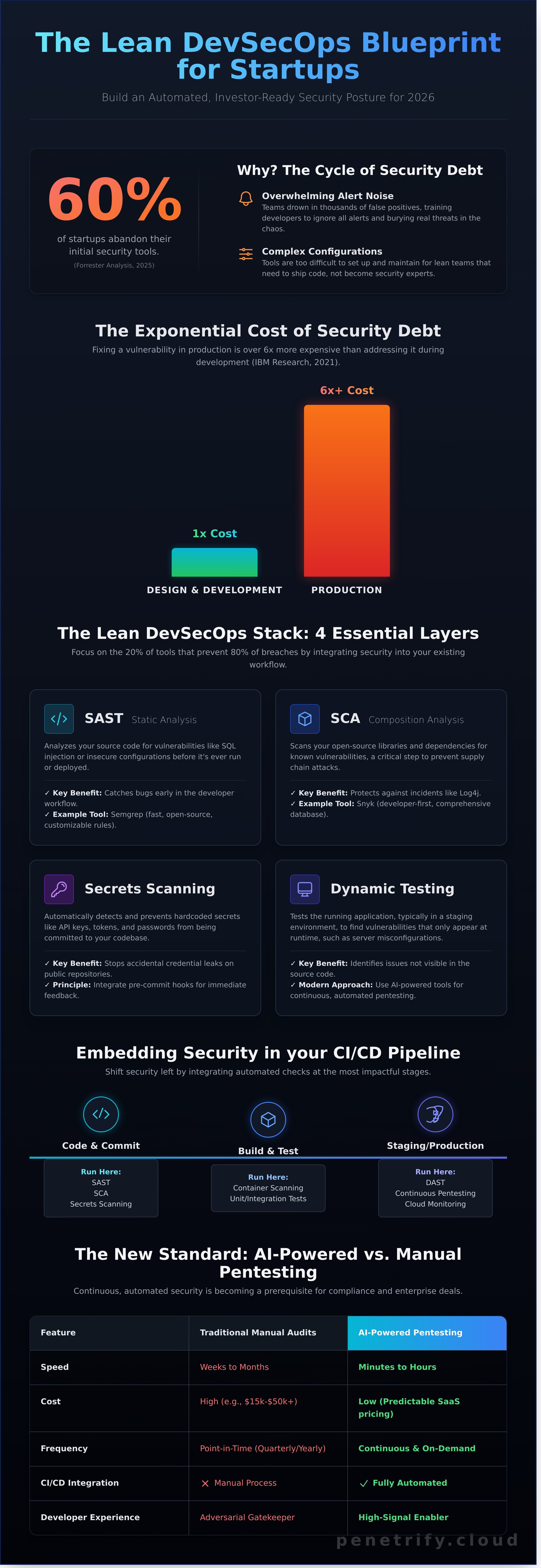
A staggering 60% of startups abandon their initial security tools within the first year, according to a 2025 Forrester analysis. Why? The primary culprits are overwhelming alert noise and configurations too complex for a team that needs to ship code, not sift through thousands of false positives. It's a frustrating cycle that leaves developers ignoring alerts and real threats buried in the chaos.
If you're building fast and don't have a dedicated security team, that probably sounds painfully familiar. You need security that enables speed, not a system that acts like a roadblock. This guide cuts through the noise. We've curated a lean stack of the best devsecops tools for startups in 2026 that integrate directly into your CI/CD pipeline, deliver clear, actionable reports, and won't drain your runway. You'll get the exact blueprint for building an automated, investor-ready security posture that works for your team, not against it.
Key Takeaways
- Discover how to avoid costly "security debt" by integrating automated security checks early, turning security from a roadblock into a high-velocity enabler.
- Get a curated list of essential devsecops tools for startups, focusing on the two most critical categories for catching vulnerabilities in your code and dependencies.
- Learn how AI-powered pentesting can replace slow, expensive manual audits, providing continuous security that aligns with a rapid, agile release cycle.
- Discover the most impactful places to integrate security scans within your existing CI/CD pipeline for maximum effect with minimal friction.
Table of Contents
- The Startup Security Debt: Why DevSecOps is Non-Negotiable in 2026
- The Lean DevSecOps Stack: 4 Essential Tool Categories
- AI-Powered Pentesting vs. Traditional Manual Audits
- Implementing DevSecOps in Your CI/CD Pipeline
- Penetrify: The Autonomous Security Engineer for Your Startup
The Startup Security Debt: Why DevSecOps is Non-Negotiable in 2026
The Silicon Valley mantra of "move fast and break things" is officially obsolete. In its place is a far more durable principle: move fast and secure things. For lean startups, ignoring security in the early stages creates a dangerous liability. Security Debt is the accumulated risk of unpatched vulnerabilities and ignored security best practices, growing more expensive to fix over time. By 2026, this debt won't just be a technical problem; it will be an existential threat to your company's valuation, compliance, and customer trust.
DevSecOps fundamentally reframes this challenge. Instead of treating security as a final, adversarial gatekeeper that blocks releases, it integrates automated security checks directly into the development pipeline. This cultural and procedural evolution, building on the principles of DevOps and DevSecOps, transforms security from a bottleneck into a high-speed enabler. It's about empowering developers with immediate feedback, not policing them with a checklist weeks after they've moved on to the next feature.
The financial incentive is staggering. According to 2021 research from IBM, fixing a vulnerability discovered in production is over six times more expensive than addressing it during the design and development phase. For a startup, that's the difference between a minor code change and a catastrophic, all-hands-on-deck incident that can lead to customer churn and reputational damage.
This shift is also being driven by market forces. Achieving compliance certifications like SOC 2 or ISO 27001 is becoming a prerequisite for closing enterprise deals. By 2026, auditors will expect to see automated, repeatable security controls embedded in your CI/CD pipeline, often implemented through effective devsecops tools for startups. Manual processes are no longer defensible. They want proof of continuous security, not a point-in-time penetration test from six months ago.
However, not all automation is created equal. A "High-Signal" mindset is critical. Startups can't afford to drown their small engineering teams in thousands of false positives. A security tool that generates 99% noise is worse than no tool at all; it trains developers to ignore every alert. The best devsecops tools for startups are those that deliver a small number of high-confidence, actionable findings that can be fixed immediately.
From 'Move Fast and Break Things' to 'Move Fast and Secure Things'
The myth that security kills velocity comes from the era of manual reviews. Waiting a week for a security team to approve a pull request is a massive bottleneck. Automated security scans integrated into the CI/CD pipeline provide feedback in minutes, not days. This builds a culture where developers own security, giving them the power to identify and fix issues within their existing workflow, long before they become a production crisis.
The 2026 Threat Landscape for Emerging Companies
Startups are no longer under the radar. AI-driven botnets constantly scan the internet for low-hanging fruit like exposed API keys or unpatched services, making every startup a prime target. Furthermore, rapid development relies heavily on third-party and open-source libraries, creating significant supply chain risk. A single vulnerability in a dependency, like the Log4j incident in late 2021, can expose your entire application without you writing a single line of insecure code.
The Lean DevSecOps Stack: 4 Essential Tool Categories
For a startup, speed is everything. But moving fast can't mean breaking security. A lean DevSecOps stack automates security directly into your workflow, focusing on the 20% of tools that prevent 80% of common breaches. Instead of a dozen complex platforms, your team needs a focused set of capabilities integrated directly into the development lifecycle. This approach prioritizes four critical areas: static code analysis, software composition analysis, secrets management, and dynamic testing.
These categories represent the foundation of modern application security. They shift protection from a final, pre-release gate to a continuous, automated process that begins the moment a developer writes their first line of code. Getting these four right is the most efficient way to build a resilient product from day one.
SAST and SCA: Securing the Codebase
Static Application Security Testing (SAST) and Software Composition Analysis (SCA) are your first line of defense. They analyze your source code and its dependencies for known vulnerabilities before anything is ever deployed. When evaluating devsecops tools for startups in this category, two leaders emerge for 2026:
- Semgrep: A fast, open-source engine that excels at custom rule creation. It's ideal for enforcing your team's specific coding standards and catching nuanced bugs that generic scanners might miss.
- Snyk: A developer-first platform that combines SAST, SCA, and container scanning. Its major advantage is its comprehensive vulnerability database and seamless IDE integration, providing real-time feedback to developers.
Beyond scanning, you must automate patching. Tools like GitHub's Dependabot or Mend's Renovate automatically create pull requests to update vulnerable packages, reducing your exposure to supply chain attacks like the Log4j incident (CVE-2021-44228). To implement this without developer friction, set your 'fail-build' CI/CD checks to trigger only for new 'Critical' or 'High' severity issues in a pull request. This focuses effort on immediate risks, not overwhelming the team with legacy debt.
Secrets and Identity: Hardening the Infrastructure
According to GitHub's 2023 Octoverse report, over 10 million secrets were leaked in public repositories. Relying on .env files makes you vulnerable to a single accidental commit. Centralized secrets management is non-negotiable.
- Doppler: A user-friendly, cloud-based platform that syncs secrets across all environments. Its simplicity makes it a perfect starting point for startups.
- HashiCorp Vault: A powerful, self-hosted solution offering granular access controls and dynamic secret generation. It requires more setup but provides ultimate control over your security posture.
Enable automated secret scanning in your Git provider immediately. GitHub Advanced Security, for example, can detect over 200 token types from providers like AWS, Stripe, and Twilio. Complement this by adopting zero-trust principles for your team's access. This starts with enforcing the principle of least privilege in your cloud IAM. A CI/CD service account, for instance, should only have permissions to push a container image, not administer your entire Kubernetes cluster.
Finally, you need to test your running application. SAST and SCA can't find misconfigurations or business logic flaws that only appear at runtime. Dynamic Application Security Testing (DAST) scans your live application, simulating external attacks to find vulnerabilities. While traditional DAST scanners can be noisy, modern platforms now offer continuous pentesting to validate findings and provide actionable remediation advice, bridging the gap between automated scanning and expert analysis.
AI-Powered Pentesting vs. Traditional Manual Audits
The traditional security model is broken for modern startups. A single manual penetration test from a consultancy can cost anywhere from $15,000 to $30,000 and take two to four weeks to deliver a static PDF report. This model is completely misaligned with a team that ships code multiple times a day. By the time you get the report, the application has already changed. It’s an expensive snapshot in a world that demands a continuous motion picture.
This friction forces a difficult choice: ship code fast or ship it securely. You can’t do both with outdated audit methods.
AI-powered agents offer a way out of this dilemma. They aren't just glorified vulnerability scanners checking for known CVEs. Sophisticated AI agents simulate the logic a human attacker would use. They learn your application's API endpoints, understand its access control patterns, and then systematically try to break them. This allows them to uncover complex business logic flaws and authorization vulnerabilities like Insecure Direct Object References (IDORs) that basic scanners consistently miss. They test every build, not just one per quarter.
For lean teams, the value proposition is continuous monitoring with minimal effort. Instead of a massive, disruptive audit, you get a 'set it and forget it' system that provides a constant stream of feedback directly into your development workflow. Compare a $20,000 annual pentest to an automated SaaS platform. The automated tool provides 365 days of continuous testing for a fraction of the price of a two-week manual audit. This shift in ROI is why modern devsecops tools for startups are built around intelligent automation.
The Rise of Autonomous Security Agents
Legacy DAST scanners struggle with modern single-page applications (SPAs) and complex user flows. AI-powered crawlers, however, can intelligently map out these applications just like a human would, ensuring comprehensive coverage. This evolution marks the critical shift from simple 'vulnerability scanning' to true 'automated penetration testing'. The goal isn't just to find vulnerabilities; it's to validate their exploitability, significantly reducing the 'human-in-the-loop' requirement for initial security validation and cutting down on false positives by over 90%.
When Do You Still Need a Human Pentester?
Automation is powerful, but it’s not a silver bullet. The best approach follows the 80/20 principle. Let AI and automation handle over 80% of the common attack vectors (like the OWASP Top 10) continuously. This reserves your valuable security budget and your team's time for human experts to focus on the 20% of highly nuanced, context-specific business logic that still requires human creativity. You still need a human for certain high-stakes situations:
- Compliance Mandates: Certifications like SOC 2 or ISO 27001 often require a formal, 'human-signed' attestation that an automated report can't provide.
- Complex Logic: Testing a multi-step financial transaction or a unique business workflow may require a human's contextual understanding.
This is where hybrid solutions bridge the gap. Platforms like Penetrify integrate semi-automatic services, using AI for exhaustive discovery and then leveraging human experts to validate critical findings and author the compliance-ready report. You get the speed and scale of AI with the final assurance of human sign-off, making it one of the most efficient devsecops tools for startups on the market.
Implementing DevSecOps in Your CI/CD Pipeline
Theory is one thing; execution is everything. Integrating security directly into your Continuous Integration and Continuous Deployment (CI/CD) pipeline is where DevSecOps transforms from a concept into a competitive advantage. For a startup, this process can't be a bottleneck. It must be automated, efficient, and provide clear signals without overwhelming your small team. The right devsecops tools for startups make this possible by embedding security into the daily workflow of your developers.
Here’s a practical, four-step framework for weaving security into the fabric of your development lifecycle.
- Step 1: Scan Before You Merge. The earliest, cheapest time to find a vulnerability is before it ever enters your main codebase. Integrate automated secret scanning (for API keys, passwords) and Software Composition Analysis (SCA) to check for vulnerable open-source libraries. These checks should run on every pull request (PR), blocking a merge if high-severity issues are found. A 2023 Synopsys report confirms that fixing a bug post-release can cost up to 30 times more than fixing it pre-commit.
- Step 2: Run Lightweight SAST on Every Build. Static Application Security Testing (SAST) analyzes your source code for potential flaws. On every build, run a fast, lightweight SAST scan focused on high-impact vulnerabilities like SQL injection or cross-site scripting (XSS). The goal isn't 100% coverage; it's catching 80% of common errors in under two minutes to maintain development velocity.
- Step 3: Trigger DAST on Staging Deployments. Once your code is deployed to a staging environment, it's a running application. This is the perfect time for Dynamic Application Security Testing (DAST), which probes your application from the outside, just as an attacker would. This step finds runtime and configuration issues that SAST can't see. You can automate your DAST and penetration testing with Penetrify to run after every successful staging deployment, ensuring continuous real-world validation.
- Step 4: Centralize All Findings. Your CTO doesn't have time to log into four different security tools. All findings from SCA, SAST, and DAST scans must be aggregated into a single dashboard. This provides a unified view of risk, helps prioritize remediation efforts, and makes it possible to track security improvements over time.
GitHub Actions and GitLab CI: The Startup Standard
These platforms are the command center for most startups. Use their native CI/CD capabilities to orchestrate your security scans. A simple workflow can trigger a DAST scan using a webhook after a successful deployment job. To avoid "vulnerability fatigue," configure your tools to automatically ignore "Low" severity findings and set up Slack or Teams alerts only for "Critical" and "High" issues that require immediate attention from the engineering team.
Measuring Success: Security KPIs for Startups
You can't improve what you don't measure. Tracking a few key performance indicators (KPIs) demonstrates the value of your DevSecOps program. Focus on metrics that connect security efforts to business velocity.
- Mean Time to Remediate (MTTR): How fast are you fixing vulnerabilities? Aim for an MTTR of under 24 hours for critical issues and under 7 days for high-severity ones.
- Vulnerability Density: Track the number of new vulnerabilities per 1,000 lines of code. A downward trend proves your code quality and security practices are improving.
- Deployment Frequency vs. Security Blocks: Your security gates should be effective but not obstructive. Track the percentage of builds blocked by security findings. A healthy ratio should be below 5%, proving that security is enabling, not preventing, rapid deployment.
Penetrify: The Autonomous Security Engineer for Your Startup
For a lean startup, traditional penetration testing is a non-starter. The process takes 4-6 weeks and can cost upwards of $20,000, a timeline and budget that simply don't align with rapid development cycles. Penetrify changes the equation by acting as your autonomous security engineer, automating the entire OWASP Top 10 testing process and delivering results in under 30 minutes, not weeks. It’s designed to find critical vulnerabilities like SQL Injection, Cross-Site Scripting (XSS), and insecure direct object references before they ever reach production.
The real power lies in its continuous, intelligent monitoring. Unlike static scanners that require constant manual configuration, Penetrify integrates with your CI/CD pipeline and learns your application's architecture. When your developers push new code, Penetrify’s AI agents automatically understand the changes, whether it's a new API endpoint or a modified user authentication flow. This means your security testing evolves in lockstep with your codebase, providing a persistent security shield without adding any operational overhead. It’s a set-it-and-forget-it solution for teams that need to move fast.
This autonomous approach provides a clear, cost-effective path to scaling securely. You can go from a fledgling MVP to a Series A-ready company without the immediate need to hire a full-time security team, which typically costs over $170,000 per year. Penetrify bridges that gap, offering enterprise-grade security for a fraction of the cost. This makes it one of the most essential devsecops tools for startups looking to build a secure foundation from day one, ensuring you can focus your limited capital on growth and product development.
Why Penetrify is Built for Startup Speed
Penetrify was engineered for the modern tech stack. Its AI-driven agents have a deep understanding of frameworks like React, Node.js, and Django, along with both REST and GraphQL APIs. This intelligence allows it to perform sophisticated tests that generic scanners miss. The platform also delivers developer-first reports that eliminate noise. Instead of a 100-page PDF, your team gets a direct link to the vulnerable line of code, an explanation of the risk, and a concrete code snippet for the fix, all integrated directly into their existing workflow.
- Zero-Fluff Reporting: Actionable insights with code-level fixes.
- Seamless Integrations: Create Jira tickets, send Slack alerts, or fail GitHub Actions automatically.
- Context-Aware AI: Understands your application's logic, not just its syntax.
The Path to Enterprise Readiness
Landing your first enterprise customer often hinges on passing their security review. Over 90% of enterprise procurement processes now include a detailed security questionnaire. Penetrify provides comprehensive, exportable reports that serve as verifiable proof of your security posture, helping you satisfy SOC 2 or ISO 27001 requirements and close deals faster. This continuous, documented security also builds immense trust with investors, demonstrating that you are proactively managing risk and building a resilient, enterprise-ready business. Don't let security be an afterthought; make it your competitive advantage. Start your first automated pentest with Penetrify today and get a complete vulnerability report in minutes.
Secure Your 2026 Launch and Beyond
The era of treating security as an afterthought is definitively over. For startups aiming for success in 2026, ignoring early security debt is a guaranteed path to costly breaches and lost trust. You don't need a massive security team from day one; instead, a lean, intelligent approach is key. Building your foundation on the 4 essential tool categories ensures you cover your bases without slowing down development.
The most effective devsecops tools for startups are those that integrate seamlessly and deliver immediate value. This is where the shift from slow, manual pentesting to AI-powered automation becomes a game-changer. Why wait weeks for a security audit when you can get actionable vulnerability reports in minutes, directly within your CI/CD pipeline? This speed is your new competitive edge.
Ready to build a resilient product from the ground up? Penetrify is your autonomous security engineer, providing automated OWASP Top 10 coverage trusted by security-conscious development teams. Stop shipping code with a question mark. Get the answers you need in minutes.
Secure your startup with Penetrify's AI-Powered Pentesting and turn your security posture into a selling point. Your future customers will thank you.
Frequently Asked Questions
What are the most essential DevSecOps tools for a seed-stage startup?
The most essential tools for a seed-stage startup are those that cover the basics without high overhead. Start with a Software Composition Analysis (SCA) tool like OWASP Dependency-Check to find vulnerable libraries. Next, add a Static Application Security Testing (SAST) tool like Semgrep for code analysis. Finally, implement a secret scanner like Gitleaks to prevent credentials from being committed to your codebase. These three form a powerful, low-cost foundation.
How much should a startup spend on DevSecOps tools annually?
A startup should expect to spend between 5% and 10% of its total engineering budget on security, including tools and personnel. For a seed-stage company, this often starts with free, open-source tools, with a budget allocation of $5,000 to $15,000 for a specific commercial tool that solves a critical pain point. As you grow and raise a Series A, this budget typically scales to accommodate more comprehensive solutions and compliance needs.
Can DevSecOps tools replace a professional penetration test for SOC2?
No, automated DevSecOps tools cannot replace a professional penetration test for a SOC 2 audit. The AICPA guidelines for SOC 2 require an independent, human-led assessment to validate security controls against sophisticated attacks. While tools provide crucial continuous monitoring, auditors need to see evidence from a third-party pentest, which is typically required at least annually to achieve and maintain compliance.
Will adding security tools to my CI/CD pipeline slow down my builds?
Yes, security tools will add some time to your CI/CD pipeline, but it's manageable. A fast SAST scanner might add 2 to 5 minutes to a build, while a comprehensive DAST scan could take over an hour. To avoid delays, run lightweight scans on every code commit and reserve the slower, more intensive scans for nightly builds or pre-production environments. This strategy balances security with a build time increase of less than 15% for most commits.
What is the difference between SAST and DAST in a startup context?
SAST (Static Application Security Testing) analyzes your source code from the inside, before the application is running. It's like a grammar check for security flaws. DAST (Dynamic Application Security Testing) tests your running application from the outside, simulating an attacker's perspective. For a startup, SAST is easier to integrate early into the development workflow, helping developers fix issues before they even reach a testing environment.
How do I handle false positives in automated security scanners?
You handle false positives with a systematic tuning process. First, dedicate time to review and validate initial findings; some scanners can have a false positive rate over 50%. Next, use the tool's features to customize rulesets and suppress specific, confirmed non-issues. Finally, document your decisions and create a baseline file. This tells the scanner to ignore known, accepted findings in future scans, keeping your alerts relevant and actionable.
Is open-source security software enough for an early-stage company?
Yes, open-source software can be enough, but it requires a significant time investment. Tools like OWASP ZAP and Trivy provide enterprise-grade scanning capabilities for free. However, the trade-off is the lack of dedicated support and the internal engineering time required for setup and maintenance, which can consume over 10 hours per month. The right devsecops tools for startups often involve a mix of open-source and targeted commercial solutions.
How does AI improve penetration testing for web applications?
AI improves penetration testing by automating discovery and accelerating analysis, not by replacing human experts. AI-powered tools can map an application's attack surface and identify common vulnerabilities up to 70% faster than manual reconnaissance. This frees up human pentesters to focus their expertise on complex business logic flaws and multi-step attack chains, which AI models as of 2024 cannot reliably find on their own.